

A Practical Guide to Understanding Candlestick Patterns, Price Action and Trading Psychology
The financial market can often appear complicated. Price charts move up and down, news changes sentiment within minutes, and traders constantly face one important question: Should I buy, sell, or wait?
But beneath the thousands of price movements taking place every day, there is a simple story—the ongoing battle between buyers and sellers.
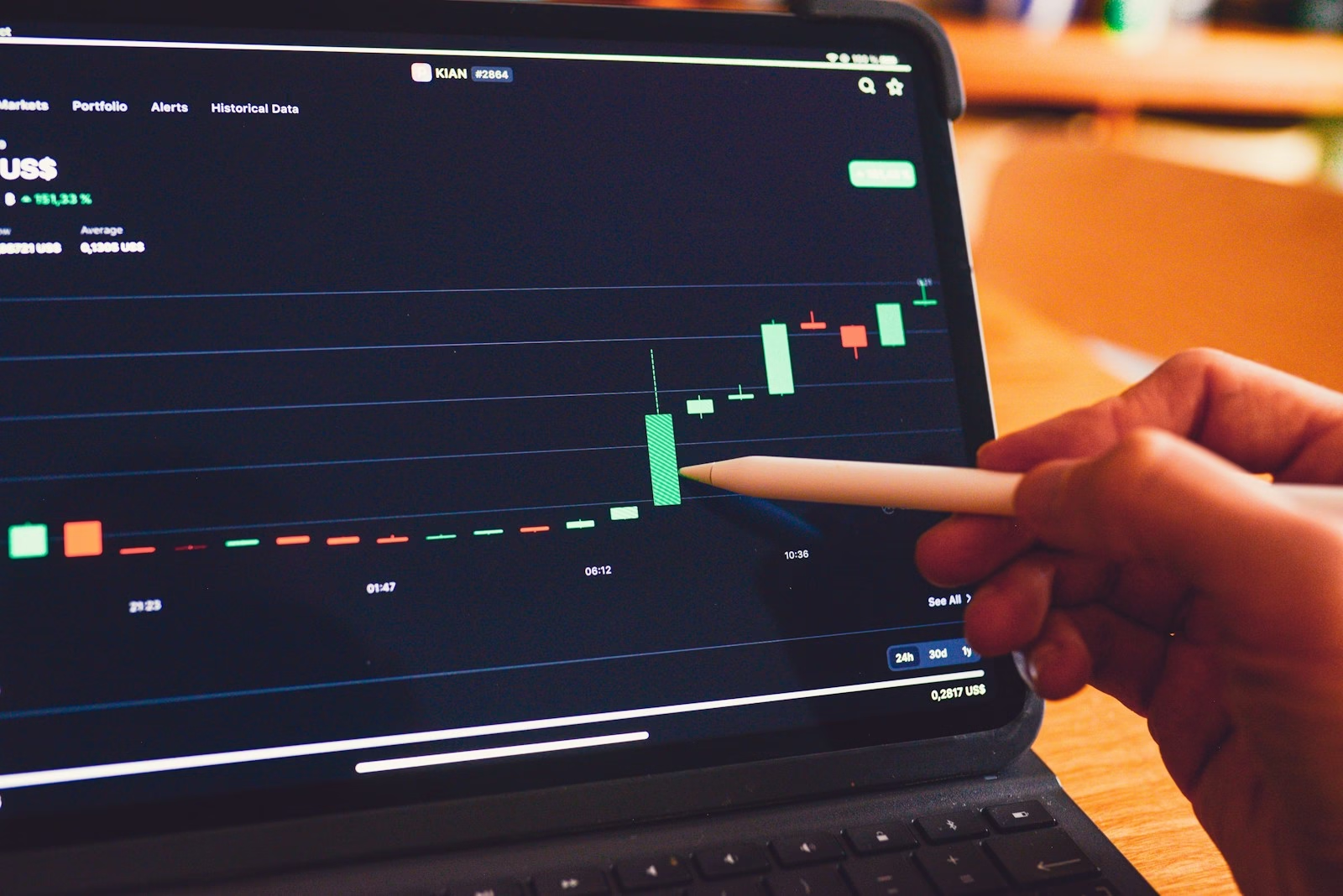
This is where candlestick charts become powerful.
Candlestick Mastery: Decode Market Sentiment for Profitable Trades is a practical guide designed to help readers understand this visual language of the market. The book explains how candlesticks reflect price action, market sentiment, buyer and seller behavior, and potential changes in market direction.
Why Candlestick Analysis Matters
Many traders begin their journey by looking at complicated indicators, financial news, charts, and technical formulas. While these tools can be useful, understanding the basic movement of price is equally important.
A candlestick is more than a green or red box on a chart. Its body and shadows (wicks) provide information about the opening, closing, high, and low prices of a trading period. The shape of the candle can provide clues about buying and selling pressure.
For example, a candle with a long lower shadow may indicate that sellers pushed the price lower but buyers stepped in and rejected those lower prices. Similarly, a strong bullish candle may indicate strong buying pressure.
By learning to interpret these clues, traders can begin to understand what is happening behind the price movement rather than simply reacting to whether the market is going up or down.
What Is Candlestick Mastery About?
Candlestick Mastery: Decode Market Sentiment for Profitable Trades takes a structured, step-by-step approach to candlestick analysis.
The book is written for people who are new to trading as well as experienced investors who want to refine their understanding of price action. Concepts are explained in simple language, with practical examples intended to make the patterns easier to recognize and apply.
The journey begins with the fundamentals before progressing toward more advanced patterns and trading considerations.
The book covers:
- Anatomy of a candlestick
- Understanding candle bodies and shadows
- Bullish and bearish candles
- Market sentiment reflected by candle formations
- Doji variations
- Hammer and Shooting Star
- Bullish and Bearish Engulfing patterns
- Bullish and Bearish Harami
- Morning Star and other three-candle formations
- Three White Soldiers and Three Black Crows
- Tweezer Top and Tweezer Bottom
- Special candlestick patterns
- Confirmation techniques
- Support and resistance
- Market context
- Candlestick limitations
- Risk management
- Stop-loss principles
- Risk-reward considerations
- Trading discipline and emotional control
From a Single Candle to Market Sentiment
One of the key ideas explored in the book is that candlestick patterns should not simply be memorized.
The real objective is to understand what the pattern may be communicating about market sentiment.
Consider a Doji. It can represent a period in which buyers and sellers are relatively balanced, resulting in little difference between the opening and closing prices. A Hammer, on the other hand, can provide clues about rejection of lower prices and a possible shift in buying interest.
The book introduces these patterns progressively, beginning with single-candle formations and then moving into two- and three-candle patterns.
This approach helps readers understand not only what a pattern looks like, but also why it may matter.
Understanding Reversal and Continuation Patterns
Markets do not always move in straight lines.
An established trend can weaken, reverse, or continue after a temporary pause. Candlestick patterns can help traders identify potential changes in market behavior.
The book introduces two-candle reversal formations such as Bullish Engulfing and explores three-candle patterns such as the Morning Star. It also examines patterns that may indicate continuation of an existing trend.
This is particularly useful for traders who want to develop a more systematic approach to reading charts.
However, an important message throughout the book is that a pattern should not automatically be treated as a trading signal.
Confirmation Is Essential
One of the most important lessons in candlestick trading is simple:
Do not rely on a single candlestick pattern.
Even a visually strong pattern can produce a false signal.
The book emphasizes confirmation through subsequent price action, volume, support and resistance, and other technical tools.
For example, a bullish pattern may appear attractive, but if it develops immediately below a major resistance level, the potential upside may be limited. The same pattern appearing near an established support zone may provide a different context.
This is why context matters.
A candlestick should be interpreted as part of the larger chart—not in isolation.
Support and Resistance: The Bigger Picture
Candlestick patterns become more meaningful when traders understand where they occur.
A bullish reversal pattern appearing near an important support zone may carry a different implication from the same pattern appearing in the middle of a trading range.
Likewise, a bearish pattern near significant resistance may deserve greater attention.
The book therefore encourages readers to combine candlestick analysis with broader technical concepts rather than treating patterns as independent signals.
This helps shift the trader’s mindset from:
“I see a pattern, so I should trade.”
to:
“I see a pattern. What is the market context, and is there enough confirmation to justify taking risk?”
That distinction can make a significant difference in trading discipline.
Candlesticks Are Not a Magic Formula
A major strength of the book is its discussion of the limitations of candlestick analysis.
Candlestick patterns can generate false signals. Market news, economic events, sudden changes in investor sentiment, and unexpected developments can all influence prices.
The book makes an important point: candlesticks are a valuable analytical tool, but they are not a complete trading system.
They can help traders visualize price action and market sentiment, but they should be incorporated into a broader trading plan that includes:
- Entry rules
- Exit rules
- Position sizing
- Risk management
- Stop-losses
- Confirmation
- Trend analysis
- Volume analysis
- Technical indicators
This makes the book particularly relevant for readers who want to develop a disciplined trading process rather than search for a “perfect” pattern.
Risk Management: Protecting Your Capital
Trading is not only about identifying opportunities.
It is also about managing what happens when you are wrong.
The book dedicates significant attention to risk management because even high-probability patterns can fail. Effective risk management can help traders protect capital, reduce emotional decision-making, survive losing streaks, and maintain discipline.
The book discusses several important principles, including:
Use a Stop-Loss
A stop-loss establishes a predefined level at which a losing position will be exited. The objective is to prevent a manageable loss from becoming a much larger one.
Control Position Risk
The book discusses limiting the amount of capital exposed to any single trade. This helps traders remain capable of continuing their strategy even after a series of unsuccessful trades.
Consider Risk-Reward
Before entering a trade, traders should consider the potential reward relative to the amount they are risking. The book discusses a 1:2 risk-reward framework as a general example.
Avoid Overtrading
More trades do not necessarily mean better results. The book encourages readers to focus on quality setups rather than trading simply because the market is moving.
Trading Psychology Matters
Technical analysis can provide signals, but traders still have to make decisions under uncertainty.
Fear and greed can cause traders to enter positions too early, exit too quickly, chase prices, or increase risk after a loss.
The book therefore emphasizes maintaining discipline and following a predefined trading plan instead of allowing emotions to control decisions.
Understanding candlesticks is ultimately not just about recognizing shapes on a chart. It is about developing the ability to interpret market behavior while remaining disciplined about risk.
Who Should Read This Book?
Candlestick Mastery is suitable for:
Beginners
If you are new to technical analysis, the book provides a structured introduction to candlesticks and progressively builds your understanding.
Stock Market Traders
If you already trade stocks, the patterns and confirmation principles can help you develop a more systematic approach to chart analysis.
Technical Analysis Learners
Readers studying price action and technical analysis can use the book as a practical reference for important candlestick formations.
Experienced Investors
Even experienced traders may benefit from revisiting the fundamentals of market sentiment, confirmation, and risk management.
The book specifically aims to make technical concepts accessible to readers with little or no prior knowledge while also offering value to experienced investors looking to refine their strategies.
A Practical Learning Journey
The book is organized to build knowledge logically—from basic concepts to more complex patterns and finally to limitations and risk management.
Readers are encouraged to proceed chapter by chapter, study the examples carefully, and visualize the patterns rather than simply memorizing their names.
This makes it useful not only as a book to read once, but also as a reference guide while studying charts.
A practical way to use the book is to:
- Learn one pattern at a time.
- Find the pattern on historical charts.
- Study the trend surrounding the pattern.
- Identify nearby support and resistance.
- Look for confirmation.
- Consider the potential risk before entering.
- Record the outcome in a trading journal.
- Review your decisions regularly.
This process can help turn theoretical knowledge into practical chart-reading skills.
The Bigger Lesson: Read the Market, Don’t Chase It
Successful trading is not about predicting every market movement.
It is about understanding the information available to you and making decisions within a clearly defined risk framework.
Every candle represents a period of interaction between buyers and sellers. When viewed together, candles can create patterns that reveal changes in momentum, indecision, rejection, continuation, or potential reversal.
The objective is not to believe that every pattern will work.
The objective is to recognize potential opportunities, demand confirmation, manage risk, and remain disciplined.
As the book explains, traders who succeed over the long term understand that consistency comes from discipline and a comprehensive strategy—not from chasing individual patterns.
Start Your Journey Toward Candlestick Mastery
If you have ever looked at a stock chart and wondered:
- What is the market really telling me?
- Why did the price suddenly reverse?
- What does this long wick mean?
- Is this a genuine reversal or a false signal?
- How can I confirm a candlestick pattern?
- Where should risk management fit into my trading plan?
Candlestick Mastery: Decode Market Sentiment for Profitable Trades provides a structured starting point for exploring these questions.
It brings together candlestick patterns, market sentiment, price action, confirmation, technical analysis, and risk management in one practical learning journey.
Whether you are taking your first steps into technical analysis or looking to sharpen your existing chart-reading skills, this book can serve as a valuable companion as you learn to interpret the visual language of the markets.
Read the Candles. Understand the Sentiment. Trade with Greater Clarity.